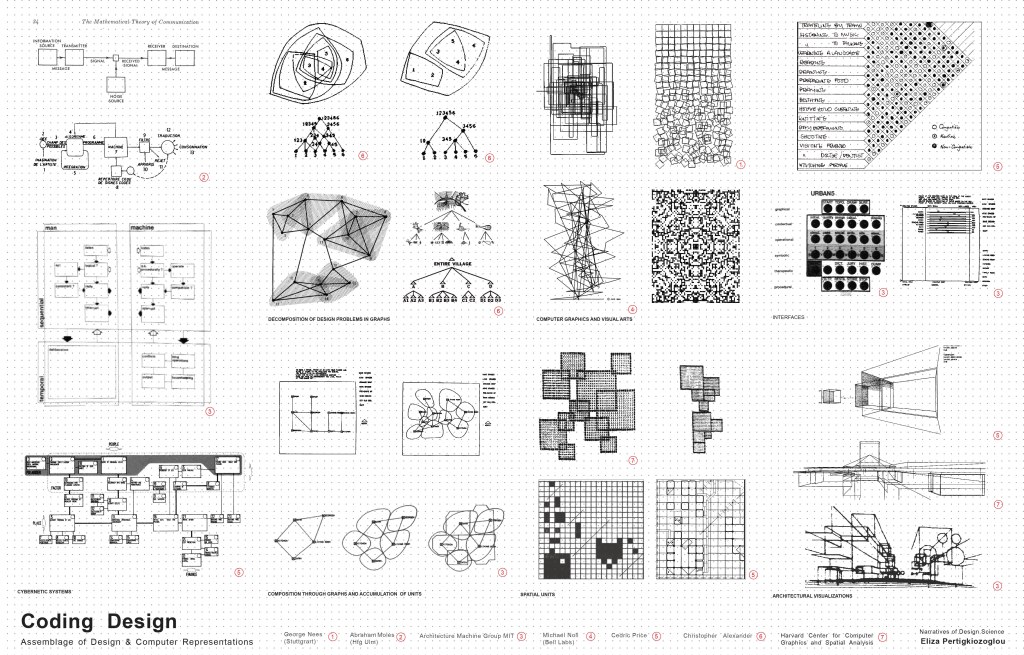
The decades of the 1960s and 1970s were marked by the advent of the modern computer, accompanied by technological positivism and a paradigm shift in the scientific world. These transformations, of course, did not leave the design world intact. Coding Design attempts to weave a narrative on how the first generations of architects and designers responded to the new medium, reimagined the whole discipline and tried to encode architecture. If the nascent cybernetics and information theory offered the conceptual framework for designing systems and man-machine interactions, computer representations of various levels (from binary machine language and algorithms to computer programming and visual displays) consisted of a new language with which they communicated with their instruments. In their effort to make architecture machine-readable, the first computational architects and designers created novel design data representations. Coding Design revisits the agenda and projects of architects and artists such as Michael Moles, Keneth Knowlton, Max Bense and Abraham Moles from Ulm, Nicholas Negroponte and the Architecture Machine Group at MIT, Cedric Price, Christopher Alexander, Allen Bernholtz at Harvard GSD in a comparative study of their visions and visuals.
Find the articles related to this research on Medium.
for DES-3350 Narratives of Design Science course at Harvard Graduate School of Design, Spring 2017
 Eliza Pertigkiozoglou