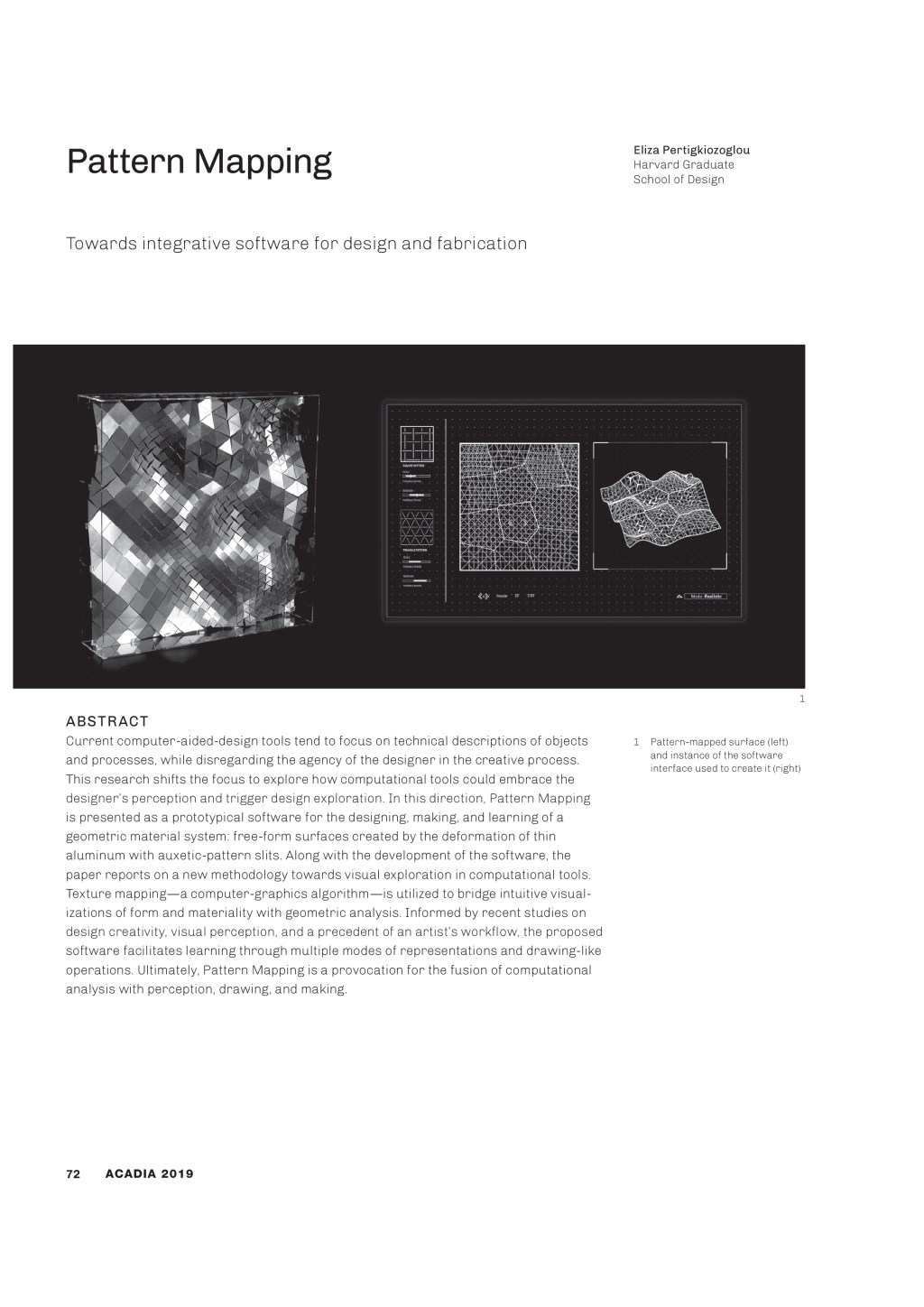
Current computer-aided-design tools tend to focus on technical descriptions of objects and processes, while disregarding the agency of the designer in the creative process. This research project shifts the focus to explore how computational tools could embrace the designer’s perception and trigger design exploration. In this direction, Pattern Mapping is presented as a prototypical software for the designing, making, and learning of a geometric material system: free-form surfaces created by the deformation of thin aluminum with auxetic-pattern slits. Along with the development of the software, the paper reports on a new methodology towards visual exploration in computational tools. Texture mapping—a computer-graphics algorithm—is utilized to bridge intuitive visualizations of form and materiality with geometric analysis. Informed by recent studies on design creativity, visual perception, and a precedent of an artist’s workflow, the proposed software facilitates learning through multiple modes of representations and drawing-like operations. Ultimately, Pattern Mapping is a provocation for the fusion of computational analysis with perception, drawing, and making.
Published in ACADIA 19:UBIQUITY AND AUTONOMY [Proceedings of the 39th Annual Conference of the Association for Computer Aided Design in Architecture (ACADIA) ISBN 978-0-578-59179-7] (The University of Texas at Austin School of Architecture, Austin, Texas 21-26 October, 2019) pp. 72-80
 Eliza Pertigkiozoglou